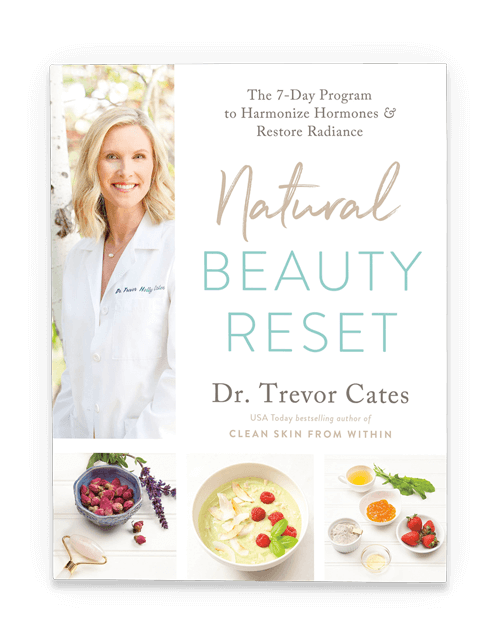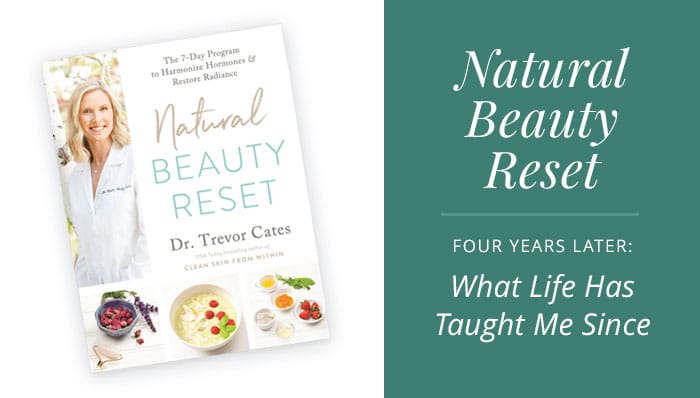
Four years ago this September, my second book, Natural Beauty Reset, was released.
Because it was my second book, I thought I was prepared for what came with publishing one. What I wasn’t prepared for was everything that would come next.
I wrote Natural Beauty Reset after more than two decades of working with women and seeing the same truth again and again: our hormones, skin, mood, metabolism, sleep, gut health, and vitality are deeply connected.
And so are the ways we eat, move, think, care for ourselves, and respond to the natural rhythms around us.
The book was designed around something I still believe just as strongly today: our needs change.
They change throughout our menstrual cycles. They change during pregnancy, postpartum, perimenopause, menopause, and postmenopause. They change with stress, relationships, illness, work, sleep, aging, and even the seasons.
We’re not meant to eat exactly the same foods, exercise the same way, use the same skincare, or expect our bodies to respond exactly the same way every day of our lives.
That idea remains at the heart of my work.
But four years later, I understand some parts of it more deeply.
A lot can change in four years
Since writing Natural Beauty Reset, I met and married my husband. I became an empty nester. I sold the skincare company I founded. And I entered menopause.
Living through those transitions has deepened how I understand my own health and how I listen to the women I care for in my practice.
And one thing has become especially clear to me:
Transitions can feel permanent when you’re in the middle of them.
If your emotions seem to change dramatically in the days before your period, it can feel like happiness is suddenly out of reach.
If you’re postpartum and exhausted in a way you didn’t know was possible, it can be hard to imagine having your energy back.
If night sweats wake you again and again during perimenopause, or your mood, sleep, weight, skin, or libido suddenly seem unfamiliar, you may wonder whether this is your new normal.
Sometimes even the uncertainty is difficult. You may go to bed wondering, or even worrying, about what tomorrow will bring.
But transitions are not destinations.
And symptoms are not simply inconveniences to suppress or suffer through. They are information.
They can be an invitation to stop, pay attention, ask better questions, and recognize that what your body needs now may be different from what it needed five or ten years ago.

Transitions can also be opportunities
I don’t want to romanticize hormonal transitions. They can be genuinely difficult.
But I’ve come to appreciate that they can also create opportunities.
Sometimes our symptoms get louder because we haven’t been listening to our bodies.
The fatigue makes us reconsider how much we’re carrying.
The sleep disruption may lead us to look more closely at stress, hormones, alcohol, blood sugar, light exposure, or our evening routines.
Changes in metabolism or body composition may invite us to look more broadly at hormones, sleep, and stress.
Mood changes may ask us to look not only at hormones, but also at our relationships, our environment, our sense of purpose, and whether our choices still fit who we’re becoming.
There may be seasons when we need to work a little harder at supporting our health.
But when we do, we may discover that our bodies haven’t failed us. They just needed a little extra TLC.
Relationships are part of our health
If I were adding a chapter to Natural Beauty Reset today, one area I would give more attention is relational health.
The quality of our relationships—whether we feel connected or isolated, understood or alone, supported, safe, and that we belong—can influence the way we experience stress and how well we recover from it.
I’ve become increasingly interested in this connection because I see how often health changes occur alongside relationship changes.
A woman may enter menopause just as her children leave home. A relationship may end. A parent may become ill. Work that once felt meaningful may no longer fit.
And sometimes the transition is joyful: falling in love, getting married, becoming a grandmother, beginning a new career, or moving somewhere new.
All of these experiences shape us. And increasingly, I believe our relationships and sense of connection deserve to be considered as part of health itself, not simply as background circumstances.
That’s why I believe supporting women well means looking beyond symptoms and laboratory values to the whole person, including the quality and perceived safety of her relationships, her sense of connection and belonging, and how supported she feels through periods of change.
The foundation still holds true
There are things I would expand if I were writing Natural Beauty Reset today, but I wouldn’t change its foundation.
I still believe our bodies have rhythms, and there is wisdom in paying attention to them.
Food, movement, mindset, and skincare matter.
Supporting healthy sleep, hormone balance, gut health, stress resilience, and the environments we live in creates an important foundation for our health and helps us move through transitions with greater ease.
Health isn’t about reaching some perfect, static state and trying to hold onto it. It’s about learning to recognize what our bodies need now and having the tools to respond.
That’s why Natural Beauty Reset moves through the seasons. Nature reminds us that change is not a disruption of the natural order. Change is the natural order.
Summer doesn’t fail because fall arrives.
A tree isn’t broken because it sheds its leaves.
And our bodies aren’t meant to remain exactly the same throughout our lives.
There are times to grow, times to restore, times to let go, and times to begin again.
Revisiting Natural Beauty Reset
Over the years, women have told me that different parts of Natural Beauty Reset have spoken to them at different times.
For some, it was the introduction and the invitation to rethink where true beauty comes from.
For others, it was the hormone chapter that finally helped connect the dots, or understanding how gut health, mood, memory, and sleep were influencing how they felt.
Many have returned to the seasonal resets when they needed something practical: a place to begin with food, movement, mindset, and skincare based on what their bodies were asking for at that time.
And for some, it was the final chapter, with questions designed to help them reflect, connect the dots, and customize the journey to what they needed most.
What I love most is that the same book can meet us differently at different stages.
The book stays the same, even as we change.
Maybe some of what I’ve learned over the last four years belongs in another book someday.
For now, if you already have a copy of Natural Beauty Reset, pull it down again and open to the chapter that speaks to what your body is asking for today. You may find that the guidance you need now is different from what you needed when you first read it.
And if you don’t have a copy yet, this may be the perfect time to begin. Whether you’re navigating hormonal changes, sleep, mood, gut health, or simply a new season of life, Natural Beauty Reset was created to help you better understand what your body needs and give you practical tools to support it.
Most of all, remember this:
When you’re in the middle of a transition, it can be difficult to see beyond it. But your body is always giving you information. The more closely you listen, the better you can support yourself through whatever season comes next.